The mid-market’s $16 billion drain
Mid-market organizations are investing more in AI than ever. Complexity is consuming the returns before they arrive.

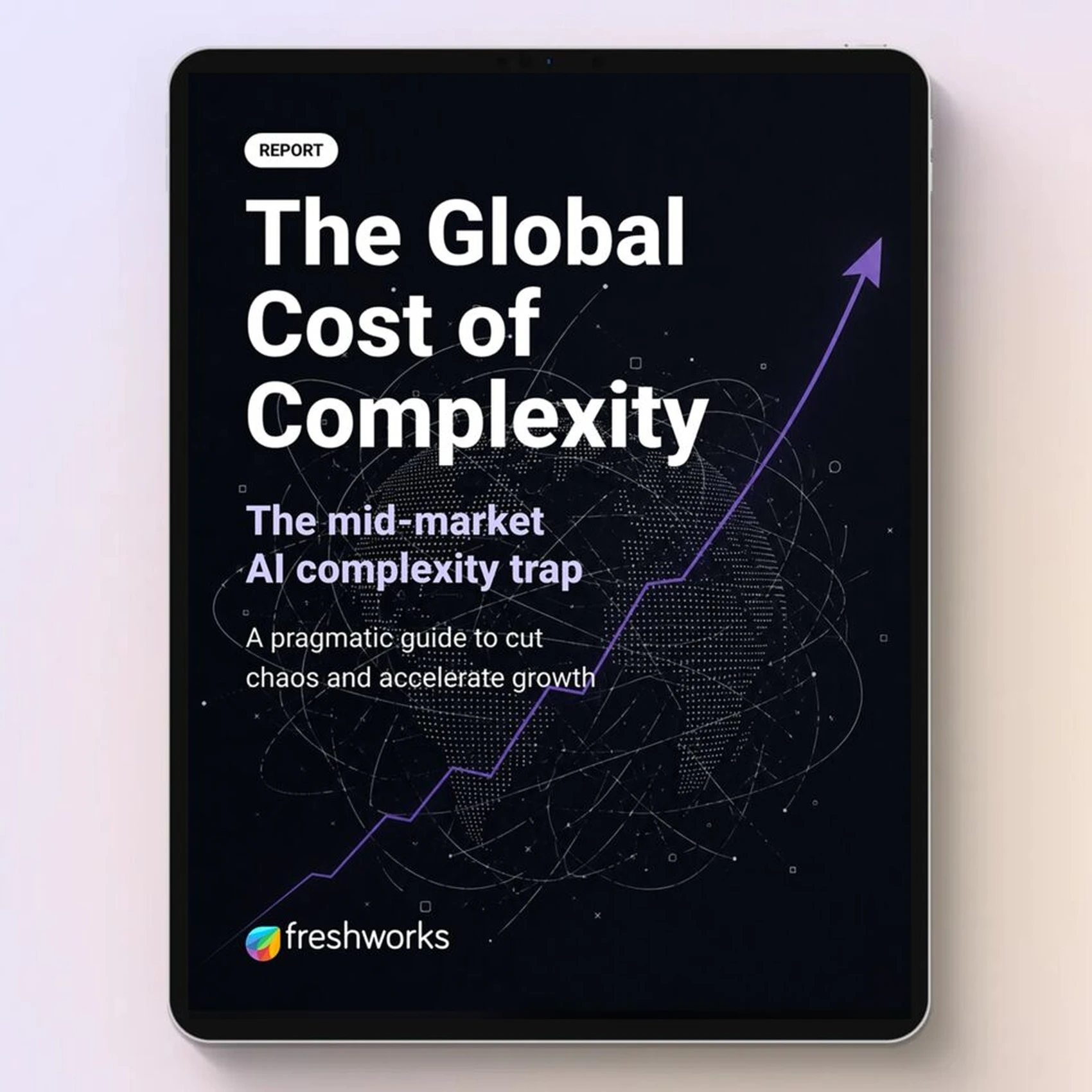


Mid-market organizations are betting big on AI. Nearly 9 in 10 IT leaders plan to increase their investment over the next two years, and 84% call it critical to growth. If only spend guaranteed results. A new Freshworks report found a sharp disconnect between ambition and execution that is costing mid-market companies billions of dollars.
The second Cost of Complexity report, based on a survey of more than 12,000 IT decision makers across six countries, finds that mid-market organizations lose a quarter of their AI budgets because of complexity overhead before results materialize. In the U.S. alone, that adds up to an estimated $16.29 billion every year.
"We see customers using AI to eliminate friction and create real value every day," says Freshworks CEO Dennis Woodside. "But success comes down to pragmatic execution, not just ambition."
The productivity paradox
Mid-market organizations expect AI to free up capacity and take repetitive work off their teams' plates so they can focus on higher-value priorities. Instead, IT teams are fielding broken integrations, wrangling data, chasing output errors, managing the support tickets those errors create, and handling governance tasks that never made it onto the project plan.
86% of mid-market IT leaders say managing AI complexity has actually increased their team's workload
26% of IT teams' AI-related time goes to troubleshooting and firefighting rather than strategic work
8 in 10 IT leaders report AI outputs introduce noise, errors, or rework
For 30%, rework from low-quality outputs ranks among their top complexity challenges
AI, the report finds, is reshaping work into review-revise-regenerate loops that erode the very efficiency gains it was meant to deliver.
89% of IT leaders plan to increase investment over the next two years, and the National Center for the Middle Market now identifies AI as the leading destination for mid-market investment dollars.
Stuck in pilot mode
AI spending is climbing fast: 89% of IT leaders plan to increase investment over the next two years, and the National Center for the Middle Market now identifies AI as the leading destination for mid-market investment dollars. But that momentum isn't translating into production-ready programs. Running pilots before committing to full deployment is a reasonable instinct, but without a pragmatic path forward, costs compound and programs stall.
Only 15% have AI integrated across multiple core business operations
36% remain in pilots or have yet to deploy meaningfully
27% cite system integration as their top barrier to scaling AI, on par with the talent shortage that gets far more attention
The pressure is acute. Nearly three-quarters of executives expect AI ROI within eight months, yet more than half of deployments take six to twelve months just to go live. That mismatch puts IT leaders in an impossible position as 81% worry their career progression is at risk if they can't show measurable returns within two years.
A pragmatic path forward
The direction mid-market leaders are heading is clear: away from adding more tools and toward making AI work within existing systems. More than a third say integrating AI into current workflows is their top priority for the next two to three years, and 90% prefer solutions with built-in workflows over heavy configuration. The pragmatic playbook to achieve true service transformation rests on four areas of focus:
Execution alongside experimentation. Set hard deployment deadlines for proven pilots and kill the rest. Measure deployment velocity, not tool count.
Integration over fragmentation. Audit every active tool, establish a single governance policy, and make governed alternatives easier than shadow AI.
Prioritization over customization. Choose platforms that work within existing systems out of the box. Treat every bespoke integration as a future maintenance cost.
Outcomes over capability. Build shared timelines that separate deployment from value realization, and define interim markers that sustain executive confidence before ROI arrives.
The mid-market advantage—agility, focus, clear ROI expectations—is real. But it only pays off when organizations stop treating complexity as the cost of doing business and start treating execution as the strategy.
Download the full Cost of Complexity report to explore all the research findings.


